

Last week, Wan Ming Ong wrote an eloquent and moving piece on her blog Wan Ming’s Wandering and Wonderings, about Saying Goodbye to horses you love. She lays out why sometimes it is better to euthanize an old horse that can no longer work, than send the horse into an uncertain future of pain and suffering, if they are ‘retired’ or ‘adopted’ elsewhere.
Firstly, horses that are in pain will still be in pain, if they are retired somewhere. This is then a case of out of sight, out of mind… where just because you don’t see the horse, you don’t have to think about that horse being in pain.
Secondly, I have moved horses on, only to find them resold or moved on again, and they have ended up being miserable; either mistreated or not cared for properly. How sure are you that the “good home” that you have found is a good home? There are plenty of horror stories on the internet, in many countries, of horses being leased or given to good homes, only to be seen a few months later, skin and bone and in a terrible state, lingering on, alive but surely better off dead in some cases.
Thirdly, horses need to be able to lie down to actually get REM sleep. They cannot do this standing up. Horses with chronic soundness issues / pain start to lie down less and less as they know they will struggle to get back up. As they rarely lie down, they end up sleep deprived with a host of other issues.
If the horse has spent most of his life with me or the riding school, it is our duty of care to make sure that he ends his final days in peace.
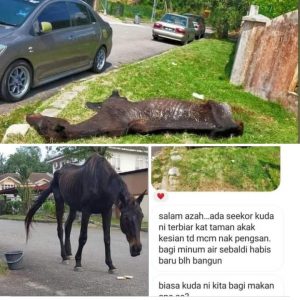

Appalling photos have been published of horses that are skin and bones, dying by the roadside. Dato’ Awang Kamaruddin has published many photos of horses in the unofficial and kampung stables that need immediate help.
Why does this happen? How can this be allowed to happen?
Unfortunately, in Malaysia, it is not enough to expect horses to survive on just grass. There just isn’t sufficient nutrition in our cow-grass that horses can survive. As you can see in the picture, they starve.
Another factor is that whatever calcium there is in the grass, it is “locked” in by oxalates. It means that horses cannot get the calcium content that is in the grass. Tropical grass is not enough. This article from Cambridge.org explains that there is actually negative calcium in tropical grasses, caused by the Oxalates:
The effects of oxalate in some tropical grasses on the availability to horses of calcium, phosphorus and magnesium
Negative calcium means the horse actually robs calcium from its bones to maintain the balance of calcium, phosphorous and magnesium in its bloodstream. What is means is that if you are having fresh grass cut and fed to your horses, while it may seem like a nice idea, you are actually doing it a disservice.
How much does it cost to feed a horse properly? Let’s do the math.
- A 55 kg bale of doubled compressed Timothy Hay costs RM187.00 or RM3.40 per kg. Most healthy horses will eat a bale a week. That in itself is RM187 x 4 bales or RM748.00 per month.
- On top of that, you add some maintenance cubes, a locally produced Stabilized Rice Bran or Supa Soy. Say 2 x 20 kg bags a month at around RM75 per bag or a total of RM150
- Throw in some salt.
- Your basic cost of feeding added up is between RM850 and RM900 per month, per horse.
That’s if you are doing it right.
Many, many stables are not doing this.
At a time when AHS and Covid lockdowns have hit the industry hard, we see a lot of horses suffering. Without income, without help from the relevant foundations, some marginal stables and riding schools have resorted to downgrading their feed. The internet is full of photos of malnourished horses, owners feeding them ruminant (cow) feed, goat, chicken or pig feed, not realising the damage they are causing to their horses.
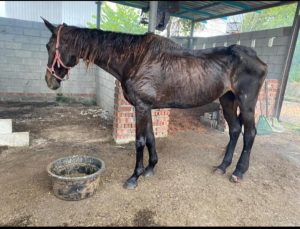

Ionophore toxicosis is a serious concern in horses.
Horses that present with acute ionophore toxicity will likely have some extent of gastrointestinal signs, colic, and fatigue. Other signs noted on presentation include a prominent jugular pulse and congested or pale mucous membranes from cardiac disturbances. Tachycardia, arrhythmias, and congestion secondary to myocardial tissue damage may be auscultated. The horse may have a weak pulse and cold extremities, sweat profusely, and display respiratory abnormalities such as dyspnea or tachypnea. Stumbling and an exaggerated gait may be seen. Urine production typically increases.
Clinical signs of toxicity usually develop within 24 hours but may be delayed for several days. Anorexia may be noted first, followed by colic and weakness caused by cardiac strain. However, the toxicosis is not always progressive. Sudden death can occur, especially after exercise. Severe hypovolemic shock can be one of the earliest signs.
Joanna Gioja, CVT
https://www.vetfolio.com/learn/article/toxicology-brief-ionophore-toxicosis-in-horses
Even if your horse survives, it may never recover.
Horses that survive ionophore toxicity may have permanently impaired heart function.
Kentucky Equine Research
https://ker.com/equinews/ionophore-toxicity-horses/


On top of feeding, you have the cost of stabling or stable rent, power and water, farriery and veterinary bills. Those are the basic costs, before any charge for a groom for looking after them.
Another rising cost of upkeep is stable bedding. The cost of sawdust, traditionally used as bedding, is at an all-time high in Malaysia. The demand for sawdust from the chipboard industry combined with the lack of supply because sawmills have had to lock down during the Covid-19 pandemic, has made sawdust extremely expensive, if you can even get it. Many stables have turned to Pine Shavings imported from Vietnam for a better product and a consistent supply, but at a higher price. That adds another RM200 to 300 to your monthly average cost of upkeep.
Your basic costs to keep a horse stabled, properly fed and groomed in Malaysia at bare minimum, is RM1,500 per horse per month.
This is the cost you incur monthly. For horses being ‘retired’ – deleted racehorses, old polo ponies or equestrian horses – to save this cost, horses that are past their ‘use-by date’, are given away for ‘retirement.’ The irony is that there are NO retirement homes for horses in Malaysia.
Where do these horses go then? They become used on beach rides, trail rides, or school horses in unsanctioned ‘riding schools’. Few of these stables have accredited coaches, or feed properly. Their safety practices are unregulated and leave much to be desired.


Most stables have not had a regular income during the MCO. It has been 16 months of irregular income, if any at all. Unable to pay feed bills to their regular equine feed suppliers, many stable owners have cut or changed their feed. Staff get furloughed, retrenched, or go unpaid. Horse care falls.
This is the fate of stables, not just in Malaysia, but around the world. My friend Lesley-Ann Masterton says, “3 of the 4 formally run Trail Riding centres in St. Ann, Jamaica, are closed because of the pandemic … 😢
Yahoo! News reported that more than 20 horses starved to death in Bangladesh.
In Malaysia, stables do not have to be registered with any authority. There are no requirements whether commercial or private. Joining an association such as the Equestrian Association of Malaysia or the Royal Malaysian Polo Association is optional, not mandatory. In any case, these associations govern competitive sport, and are not charities or welfare organizations. With no real industry organisation or registration, stables get no financial help from the government, foundations or even councils.
What financial help is there out there for the equine industry? There is nothing I can point you to. While Malaysians are generous and do care about animals, there has been no financial help from the government or equine authorities to provide some relief or to save these. If asked, I am sure netizens would be quick to offer monetary help. There is a need for a foundation that looks after the welfare of horses in Malaysia. A charity that perhaps organizes or distributes basic horse feed for the starving horses, and educates horse owners. Malaysians are by nature kind, and horse-loving. I am sure that such a charity, if properly run, would get many donations. This could save many horses’ lives in Malaysia. There are too many horses starving and dying, and too many horses that are being prematurely euthanized when I am sure there is help out there.
Emotionally, we all get attached to our horses. Saying goodbye to our horses is harder than many owners can handle. Giving them away is less emotive but how many get a true retirement? There are no horse retirement homes in Malaysia. None. Out of sight may be out of mind, but what are we really doing for those horses? All I can do is reiterate Wan Ming’s point that if you give away your horse for ‘adoption’, you are probably consigning it to a fate worse than death.
Source of Feed Costs: https://theroyalselangorpoloclub.com/wp-content/uploads/2021/06/RSPC-Fodder-Price-List-20210615.pdf
Related Links:
Exercise and Feeding During MCO
Tropical Grass is Not Enough
A Horse is not a House Pet
Recent Links:
Rage Against the Dying of the Light
HPA’s David Woodd to Retire
Fully Vaccinated
Champion Thoroughbred Sire Galileo Euthanised
Waking The Tiger
92 and Going Strong
The 2011 FIP Polo World Cup
Rolling With The Changes
Caroline Chew is Singapore’s First Olympic Equestrienne
Mark Wightman: Waking the Tiger
ZT Technical Jeans MCO 3.0 Promotion
Farewell Felipe
Parker’s Piece
Heat and Humidity at the Tokyo Olympics
Vaccinated
Amr Zedan’s Medina Spirit
Etiquette for Riders
Hong Kong joins 2021 Polo Rider Cup
Supporting Yayasan Chow Kit
African Horse Sickness Update
FEI Guidelines for Extreme Heat
FEI Videos on Heat & Humidity
Vale: HRH Prince Philip
Vale: Marcos Uranga
A Decade of Development
Equi-Gold Turmeric for Horses
RSPC Magazine Edition 3
ClickPolo Asia Feature
The Secretariat
Mobility: Riding For Polo
The Intern’s Debut
Cancellations Galore
Chris Ladbrook is Back at RSPC
ZT Botanicals


