

 Two decades ago, I wrote the Malaysian Jumping Equitation Manual. It was co-written with Lorna Fisher, who at that time was the Chief Riding Instructor (CRI) of the Selangor Turf Club Equestrian Centre (STCEC), and resident coach for the MEM’s National Coaching Accreditation Scheme. We introduced Showjumping Equitation to Malaysia. I updated this manual in 2011.
The current CRI of STCEC, Wan Ming, asked me to dig it out recently as she wants to include Showjumping Equitation classes at her next horse show. Here it is, for anyone who wishes to download it: Malaysian Showjumping Jumping Equitation Manual 2011.
Showjumping Equitation is about how well you ride on the flat and over fences and consequently how well your horse jumps. Some horses naturally have better paces and jumping technique than others and will generally score higher than others. Showjumping Equitation is not only a way to seek objective evaluation of your skills but also a discipline in itself.
If you are able to ride well in showjumping equitation classes, you have a sound basis for showjumping as well. It is important that we develop riders who are able to ride their horses well. How your horses jump depends very much on how you ride. Showjumping Equitation classes were started because this need is obvious.
I later authored two articles that ran in Equestrian.Com.My and other websites, about Showjumping Equitation. These articles are relevant today, as it was then. Here are some excerpts:
 We have concentrated our comments on the collective marks because we feel that if you can make improvements to the way you ride you will generally be able to translate that into better scores at each individual fence.
Marks are scored out of 10 for each of the categories in the collective marks. Collective marks account for 70 marks of each test. This is around 50% of your total score. You should remember that the collective marks are used to break a tie in scores in awarding placings. Therefore we have decided to discuss each of these categories separately.
LEGS – Needless to say we are looking to allocate marks to a rider who uses his legs properly. We want to see the lower leg on the horse at all times, heels down and toe slightly turned to aid the lower leg. A rider who can minimise his leg movements while maximising response is going to score well. Try to keep your legs as still as possible. A “loose” leg will lose you marks. If you have to kick your horse hard you are going to lose marks. If you need to do that, consider wearing spurs but bear in mind that excessive spurring is marked down.
If you currently use rubber riding boots you may wish to invest in a pair of leather boots. I have found that in addition to being hot, rubber boots do not allow you to drop you heels sufficiently. They are also thicker than most leather boots so you do not have as much sensitivity between your calf and the horse.
EYES – The comment we are always making is “look early to your next fence.” Many riders have the habit of looking to see where the next fence is, then for whatever reason they look away, usually down as some fixed point just in front of their horse. Then they look again at the fence when they are right in front of it. We would prefer to see riders looking at the next fence from the moment they are in flight over the previous fence, keeping their eye on it while landing, and all the way to it.
By keeping your eye on the next fence it allows you to ride a nice line to it. It also helps you to develop a good “eye” and to find a nice take-off spots. Think about it. If you don’t look at the fence till you are 3 or 4 strides away from it, how on earth are you going to make adjustments? And if you make adjustments that close to the fence they will have to be fairly major adjustments as you have only 3 or 4 strides to make them. Instead if you look at the next fence all the time you have the whole distance between the two fences to make your adjustments. That would allow your adjustments to be smaller each stride and thus more subtle. This will help you to score more points.
Keeping your eye on the next fence is an easy way to pick up marks in the collective section, and will help improve your overall riding!
HANDS – We see riders with all sorts of rein length and giving their horses all sorts of releases over the jumps. And sometimes not releasing at all! Perhaps one comment that needs to be made is that we tend to see more riders holding their reins too long rather than too short. A short rein is not necessarily pulling on the horses mouth.
Riders that can keep their hands still will generally score higher than riders whose hands can’t be kept still or worse still pull or yank at their horse’s mouths.
Releases: There are only three acceptable releases: (1) the short crest release used over small fences and verticals, (2) the long crest release that is used over oxers or large fences and (3) the automatic release where the rider gives the rein towards the horses mouth.
It is perfectly permissible, and is in fact considered good riding if you use an opening rein at some fences.
We would prefer to see riders showing us that they know how to give a clearly defined crest release over the fences. If you are going to give crest releases, do it at every fence rather than giving crest releases at some fences and automatic releases at others. That way you are telling the judges that you know what you are doing by your consistency.
If you don’t understand these terms please ask your instructor. Any EFA/MEM Level 1 instructor should be able to explain these terms to you (and teach them.) If you instructor doesn’t know what these terms are, please wonder about the quality of your instructor. There are many self-styled instructors who say they are “qualified by experience.” Many have less experience that you realise.
SEAT – Please choose to ride in either 2-point or 3-point seat. If you don’t understand these terms please ask your instructor. Any EFA/MEM Level 1 instructor should be able to explain these terms to you (and teach them.)
If you choose to ride the course in 2-point seat, it is permissible to lightly brush the saddle with your seat in the few strides before the fence.
Do not start the course in 3-point and finish the course in 2-point. It probably means you got faster through the course and thus would end up losing marks under the Paces or Rhythm and Tempo sections.
Conversely if you start in 2-point and finish in 3-point it probably means you were making quite hard work of it and had to ride hard to get your horse around.
For now, till we develop a distinctly Malaysian style, if ever, we will accept riding in any of the accepted “styles.” The American Hunter Seat, if you plot its history, has its basis in classical riding. This is possibly the style that will score you the most marks as it is a clean, elegant style.
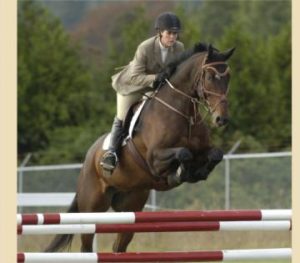 UPPER BODY – Again an easy section to score marks if you are a confident jumper. George Morris writes a wonderful section on the use of the upper body and back. The upper body should follow the movement of the horse. You should not exaggerate the movement, nor God forbid, get left behind. The lower back should be “soft” while the upper body is straight. Rounded backs get marked down.
On the flat between fences try to remember to keep your upper body straight. We tend to see many riders who are simply sloppy with their body position. Remember we are judging you on the total impression you show us. So rounded shoulders and hunched backs are going to lose you marks.
The next section deals with Paces, Rhythm and Tempo and Lines. Showjumping Equitation is not a jump-off, so please don’t ride it as one.
PACES – “Steady” is the operative word. There is no time factor in equitation, so take your time. Set a steady pace from the start and keep to it. You need to select a speed that will allow you to make the distances between fences with ease, whether they are related lines or combinations. How you select this speed depends on your horse’s normal length of stride.
If you need to approach all your fences in trot then you or your horse is not ready for the competition ring.
RHYTHM & TEMPO – Once you have selected your canter speed, please stay with it for the whole course. Chopping and changing speed with lose you marks in this section. We want to see a nice active canter, and if you have chosen a reasonable speed you will find that your horse should be able to jump the equitation height fences from almost any spot that is presented to him.
If you get a comment “like deep spot” or “long spot” it is likely that your rhythm and tempo or speed was lacking. And of course if you receive the comment “rushing” then you know you are going to lose marks in this section.
LINES – Again an easy way to score marks. This section refers not only to the related fences on the course, but also to how you ride the entire track.
Use the arena to your benefit. A Showjumping Equitation course is usually made up of a series of nice wide turns. We are looking to see that you can make the turns that allow you to ride smoothly to the next fence. Try not to take an overly wide turn – you want to show that you are able to ride a normal turn, not have to go excessively wide. There is no need to cut corners. In fact it will only lose you marks. And remember to look early.
In riding a related line, we do not really mind if you ride the line in more or less strides than the distance would normally require. i.e. if it walks as a 5-stride line and you ride it is 6 strides, we don’t mind AS LONG AS (a) you look like you had planned to ride it in 6 strides, (b) you ride it well. However if there is a related line of 4 or especially 3 strides, we would not recommend that you ride it in fewer strides.
Do not take strides out of combinations. Not only will it lose you marks but also it could be detrimental to your health.
Canter Leads and Changes – One comment that we would like to make here is about cantering on the correct lead. It is of course best if you are able to land on the correct lead after each fence. If however, you horse lands on the wrong lead, you have three options: (a) make a flying change (b) make a change through trot or (c) do nothing and ride the turn in counter canter.
Making a flying change is the best option, but you must show that you can in fact make a flying change properly. Most of the time we see riders pulling their horses into the change resulting in the horse only changing in front or going disunited. Learning to make flying changes is something that comes out of good flatwork. If you are not up to that level do not despair. Keep working at your flatwork till you are good enough to start doing flying changes. Work with a good instructor who knows what he is doing! Preferably one that can actually perform them himself before he tries to teach it to you.
If you prefer to make your change of canter lead through trot, you will NOT be marked down. We would prefer to see that you know you have landed on the wrong lead and have made a smooth transition through trot and back into canter on the correct lead.
If you do nothing and counter canter round the turn you run the risk of going disunited and you are definitely informing the judges that either (a) you didn’t even realise you were on the wrong lead or (b) you didn’t care. In either case you will be marked down.
 HORSE TECHNIQUE – This is a section that has not seen much variation in scores. As judges we have kept scores in this category within a small range so far as we wanted to encourage general participation regardless of the quality of horse that you ride.
This will have to change soon and competitors who ride horses with good natural technique will start to see greater rewards in the two categories of technique and bascule. In looking for horse technique we want to see a horse that is jumping cleanly. Tapping the poles of low fences is a clear sign that the horse is not trying hard to be clean. The front legs should be “together” and “tight.” Horses that hang a leg or droop both will have to be scored down.
The bascule is perhaps easier to judge, as it is usually quite clear if a horse is round or not. The shape that it makes over the fence should be the same each time it jumps. The most frequent comment in this category has been that the horses are jumping “hollow.” Much of the time the way the horses jump is a direct result of the way they are ridden. If you ride them “hollow” they will jump “hollow.” If you try to ride them well generally horses will try to jump well for you.
Use Of The Whip – One comment that we have had to make is simply related to bad riding and perhaps lack of education on the part of the rider. The whip should only be used as a last resort. Slapping the horse down the shoulder at each fence or even to help make a turn is simply bad riding.
The only place that the whip can be used is behind the lower leg. NOWHERE ELSE.
The whip should only be used as a matter of last resort, and not in some misguided attempt to make the horse jump better or turn. Once you use the whip in the equitation arena you are telling the judge that your horse is not listening to your leg, is not trustworthy or simply that you are a bad rider. There is little chance that you are going to win or be placed.
Use of the Voice – Similarly yelling or screaming at your horse is not going to convince the judges that you have everything under control. We’ve heard some very interesting sounds from riders on-course, and some phrases that couldn’t be printed in an article such as this. While we generally appreciate creative swearing, the competition arena is not where we’d like to hear it.
If you are going to use your voice, the only acceptable sounds are to “cluck” to your horse or to say “whoa” in a low controlled manner. Nothing else.
Turnout – While we are on the subject of impressing your judges, please bear in mind that you are a competitor from the moment you step into that arena. Even to walk the course. So please walk the course dressed as you are going to be when you compete.
Think about your turnout and what is says about you. If you try to walk the course improperly dressed you are saying that you do not have much respect for the officials who can be bothered to dress properly to judge your class. Then you hope that these same people who you have just insulted are going to give you good marks. Not a particularly clever way to try to score points.
So the next time we find a competitor trying to walk the course in sneakers, half-way or otherwise improperly dressed, we will kick you out of the arena for your own good. And then you should count yourself lucky if you are still allowed to compete.
Still on the subject of turn-out, it is clear that some riders make absolutely no effort to turn their horses and themselves out smartly, while some riders go to great extent to present themselves and their horses in the best possible light. We have not been allocating marks for turnout, but this will change shortly. Competitors who make the effort have to be rewarded.
On the whole we have seen good interest in showjumping equitation classes and we have been encouraged by your participation. Equitation classes should lead to better all around riding skills and in the long run will help to raise standards. We are happy to help you if you do not understand any of the terms we have used in the test sheets or in this article. Again, any EFA/MEM Level 1 instructor should be able to explain these terms to you (and teach them.)
You’ll also find that by reading up on the subject you will have a greater understanding of what we are all looking for as riders and judges. One book that I have found to be of great help to my riding even today is George Morris’ “Hunter Seat Equitation.” It is an excellent resource book that I still use even as I prepare to jump in World Cup competitions. This book is available over this website from Amazon.Com.
Another book that I have found to be an excellent source of motivation and common sense with horses is William Steinkraus’ “Reflections on Jumping and Riding,” subtitled “Winning Techniques for Serious Riders.” It is also a standard on what is now called “classical” equitation.
Both books mentioned are by American authors who have been acknowledged as the best in the world as riders and/or trainers. There is a tendency perhaps in George Morris’ book to concentrate on style as an end in itself, but Steinkraus’ book is exceptionally practical. While we have yet to develop a distinctly “Malaysian” style of riding, possibly because of the wide variation of types of horses that we have competing here, it would be helpful if riders would try to adopt an established style. Whichever they choose, whether American, French, German or even “Australian” is acceptable, but it should be clear to the judges that they are actually trying to ride in a particular style and not a mish-mash of different styles over different fences.
We hope that competing in showjumping equitation classes have been a positive experience and that this article helps you to enjoy it even more.
Having recently taught the occasional jumping lesson and some clinics, I know that these remarks are still relevant. I hope this article helps riders to improve their showjumping equitation and their jumping in general.
Related Links:
Are Online Shows the New Normal
A Zoom Show
Managing a Second Lockdown
RSPC Pony Club Polo Camp by KL Academy of Polo
D-Day Dressage Extravaganza
Federation of International Polo
KL Academy of Polo


