

The coronavirus pandemic and AHS scare have conspired to wreck equestrian shows this season. The EAM has moved to adapt to the times, starting a series of “digital” competitions. The concept is that competitors stay at their home club, and jump a prescribed course, or do their dressage tests there, while the judges do the judging by zoom. Their results are tabulated nationally to find the winners of each height class or dressage level. The concept is like an FEI World Challenge, but held nationally, and judged on-line.
The first competition was held a few weeks ago. I watched it on zoom as I was being given the privilege of doing the course design for the EAM’s Digitalization Competition 02/20 to be held this Saturday 7th November.
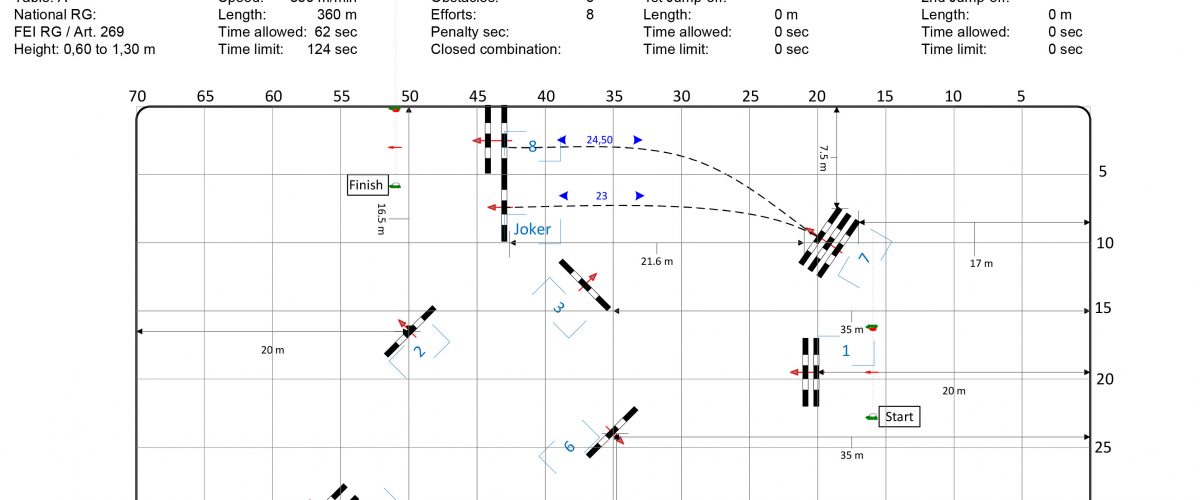
It was an interesting exercise in designing the course plans for this digitalized show jumping event. Because everyone will be competing in their home clubs, the courses should be built as similarly as possible, not only in height and spread and distance from each other, but also their exact locations in the arena. Therefore, I tried to include as much detail as I could, so that everyone can build their courses as similarly as possible, so that this event is as fair as we can make it for all competitors taking part.
 Because not all participating clubs have the same jumping equipment, we had to build using the lowest common denominators. That meant no fillers, walls or water trays. All the fences had to be designs using only poles.
With only eight fences possible, again limited by the number of poles a club has, the EAM decided on using an Accumulator as the class type.
I asked for a slightly longer arena at 70 x 40 m for this competition, 10 m longer than in the first show, which was held in a dressage arena length of 60 m.
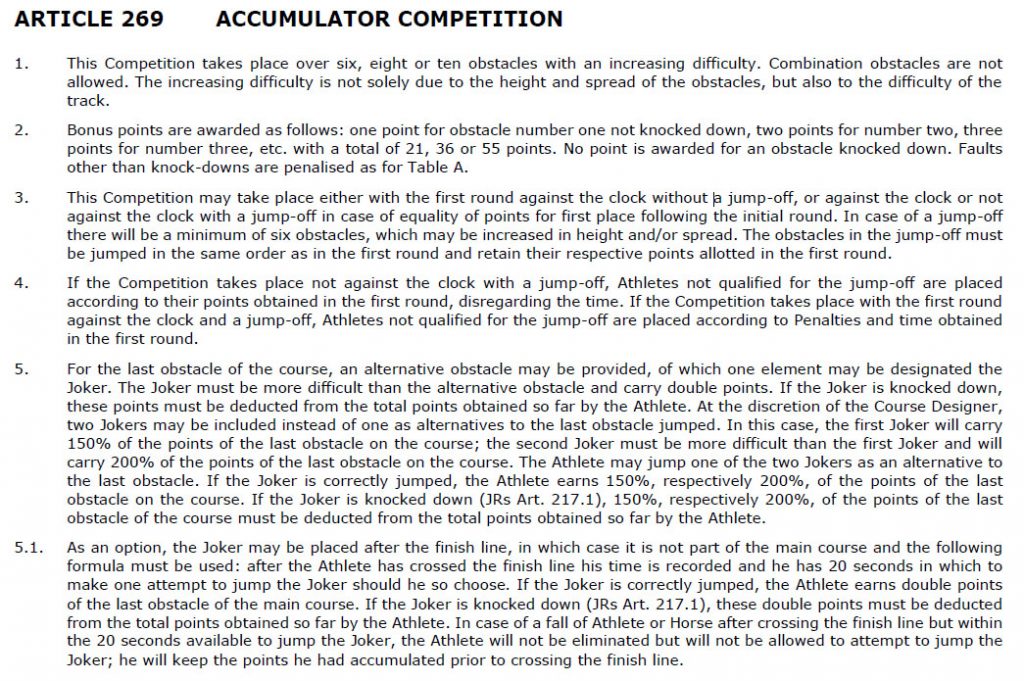
I designed the accumulator with eight fences, with one Joker inside the course, per article 269.5.
I use a course designing program called PPD, which is developed to run using another program called Visio. It allows for much greater detail. I added 5 meter markers, and dropped a grid over my course plans.
I don’t usually do this if I am building the course myself, as I know I would be there to see for myself the angles and turns as I create the course. Designing for others to build in many different venues meant I had a responsibility to design with as much detail as possible, so that the courses in different venues will be as similar as possible.

If this is the new normal of horse shows, we have to strengthen our protocols and improve how we can run these shows. Therefore, I also did a worksheet of building instructions for all classes.
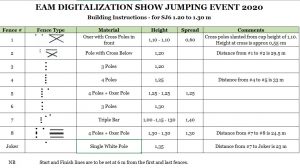 While we have no control of the different footing at each venue, or the weight of the poles, hopefully these plans and details will help all competitors have a fair crack at this.
If anyone has ideas that we can incorporate to strengthen the protocols for these zoom shows, please let me know.
I wish everyone the best of luck with this competition.


