

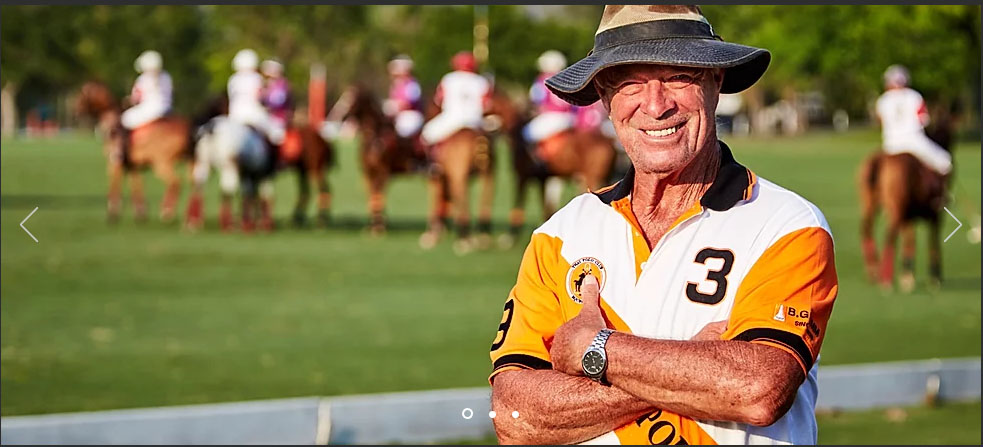
Rege Ludwig has authored two articles on the rules of polo and umpiring, which he has given me permission to publish here on my blog. Here is his second article that we have been given permission to publish.
FEEDING THE BUTT
There is much talk today about speeding the game up and making it safer. Well, as things stood fifty years ago, those same two topics were talked about, and with the same degree of fervor, as they are today. In fact, one of the greatest polo players of all time, Memo Gracida, was moved to the point of writing an article for the then USPA Polo Magazine on that very subject.
If my memory serves me correctly, in that article Memo refers to a defending player entering the ROW in front of another player to slow them down as, Feeding The Butt, which is not so different then the modern term of – Blocking. Both are used to upset the flow of the offensive team to slow them down in hopes of their losing possession of the ball; and, to give defensive teammates more time to mark their offensive opponents. Memo’s contention was that because Feeding of the Butt is so potentially dangerous, it should not be condoned.
Imagine in a football game, (soccer), an offensive player makes a quick maneuver to run down field to receive a pass, and just in time, a defensive player grabs the offensive player by the arm and holds them back, Foul??? FOR SURE. Well!!! Feeding the Butt, or Blocking, creates the exact same effect of slowing the offensive player down. However, Feeding the Butt, or Blocking in polo is so much more potentially dangerous to both the human and the equine players.
Again, if my memory serves me correctly, Memo effectively stated that the player with the right, or precedence, to hit the ball should know that when they look down to the ball, and go to the whip to get there, they can close their eyes and not have to worry about a defending player entering their ROW, i.e., Feeding The Butt, or Blocking, in front of them to slow them down.
Because speeding the game up and making it safer are still fervently talked about issues, one can only assume that neither issue has been resolved. That has me wondering – WHY!!!, after fifty years, or more, the same problem still exists, and to a greater degree.
Could it be that the rules are not written to where they are sufficiently clear and concise so as to be enforceable? Another possibility is that the authorities who have had the responsibility of enforcing the rules, over the last fifty years, have not been sufficiently forceful in their efforts of enforcing the rules to create the effect for which they were written, i.e., create safety, speed, and fairness of play for all players involved in the game (human and equine).
The problem of a lack of resolve, probably falls somewhere between the two scenarios. If we are truly a concerned community of polo players, we must stop talking about the problem, determine where the problem lies, address it, and resolve the issue so a resolution is not forced upon us from outside our community of polo players, which is not outside of the realm of possibility.
The problem of blocking, or Feeding the Butt, is not disappearing. As a matter of fact, I feel quite comfortable in saying that most polo players who have been playing polo for twenty, thirty, or even forty, will tell you that the problem of Feeding The Butt, Blocking, is greater today than it has ever been. According to Memo, who is still an active player, “That is just the way polo is played today.” I truly do understand that forty years ago is not today, and that things and times change. However, when that statement is put into perspective, it truly is a sad commentary for the state of the modern day game and sport of polo.
I seriously doubt that the intention of the rules is to protect the highest rated player and better horse in a game more than the lowest rated player and the lesser horse. If common sense were to prevail, the opposite is true. However, the reality of the situation is, the rules of the game are intended to be applied equally to all players in a game, and the over-riding prerequisite should be the safety and fairness of play as applied from the lowest to the highest level of playing ability in a game.
When there is a zero, a one, or even a two goal player in a game with high or medium goal level players, a play that would have not been a foul in a thirty-five goal game could easily be consider a foul at the 10, 15 or 20 goal levels of play.
Not allowing Feeding of the Butt does not suggest that the defensive player is being denied a play on the offensive player. What it is suggesting is, the defensive player must make their play earlier, and do it back along side of the offensive player rather than in front of them to slow them down.
HPA Rule 32. RIDING OFF. A player may ride off an opponent provided that the ponies are travelling at the same speed, are shoulder to shoulder and come together at a safe angle… .
USPA RULE 25 – STOPPING ON BALL
b. A player who has safely entered the Right of Way of another player along the projected path that the ball has yet to travel, whether meeting or following the ball, may not slow down or stop in that other player’s Right of Way.
A truly unfortunate aspect of this whole – make the game faster and safer scenario is – the rules that govern those situations have been in the rulebook for fifty years (or more), using basically the same words, every year:
HPA rule 24, c. No player shall enter in front of the player on the LOB except at such a speed and distance that not the (“slightest risk”) of danger to any player is involved…
USPA RULE 12, b. – RIGHT OF WAY
No player may enter, cross or obstruct the Right of Way of the player entitled to it unless at such a distance that (“no risk”) of collision or danger to either player is involved.
From the way I understand those two rules, once the offensive player has complied with the rules, and has safely established within the right to hit the ball, that offensive player must be given every benefit of doubt to proceed safely within the established ROW to the ball. Any maneuver the defensive player makes that could be construed as creating the slightest risk of danger to any of the players (humane or equine) must be considered a foul; and as such, that maneuver must evoke the immediate response and retribution of the whistle.
I follow that statement with my favorite rule of all time: USPA rule 26 Dangerous Riding, Subparagraph e. – Exhibiting a lack of consideration for the safety of one’s self, one’s mount, or for another player or mount.
I remember telling my classes over the years, “Polo does not need any rules other than USPA Rule 26 e. With a clear grasp of that one rule, the umpires and the referee can control the safety, fairness, and speed of play of any level of game. The problem with that rule is, the umpires and the referee must be made stringently aware of what a lack of consideration for safety means relative to the level of the game being played.”
The HPA rule that is most close in intent is APPENDIX B Guidelines for Game Officials RULE 17 – Line of the Ball and Precedence: As a general principle, the player who creates the danger should be penalised. It is important to try to be consistent in what is blown and what is allowed.
When the rules are not enforced by way of the whistle, the players are effectively being told that they can determine their own interpretation of, “Slightest Risk of Danger.” The problem with that situation is that there will be a huge difference of opinion between the offensive and the defensive players as to how the Slightest Risk of Danger should be applied to any particular play. Not only that, according to HPA Rule 29 and USPA Rules 30 and 33; players are forbidden to express their opinions on the field, verbally or by gesture, during the course of the game.
HPA Rule 29 – UNSPORTSMANLIKE CONDUCT states : No player, team or member of a team’s organization may behave in a way which is inappropriate or risks bringing the game into disrepute. The following are examples of what may be considered to be unsportsmanlike conduct and may lead to the umpires awarding a red or yellow flag in addition to any penalty:
a. Showing disrespect or using vulgar or abusive language or gestures to any official, player, coach, or spectator. This includes continuing to appeal or argue with the umpires or officials, verbally, by gesture or with a stick.
While USPA RULE 30, – APPEALING A FOUL states: No player may appeal in any manner to the Umpire for a foul… . In my opinion that rule should read, “for or against a foul.”
USPA RULE 33, – UNSPORTSMANLIKE CONDUCT states:
Unsportsmanlike conduct, including but not limited to the following, shall not be permitted
a. Vulgar or abusive language
b. Disrespectful attitude toward any official, player, coach or spectator
c. Arguing or unwanted talking with umpires or other officials …
I was inspired to write this article by three separate incidences. The first was the article in the July 2017 issue of the Polo Times Magazine, Your Views on Blocking. Another incident was a play I recently had the unfortunate experience of witnessing. The play was so potentially dangerous; I still cannot believe I saw what I saw.
The scenario was as follows: A defensive player had Feed the Butt to the offensive player with the ball by being completely crossways of the two projected ROWs in front of the offensive player. The block was so successful that the offensive player had to turn their horse and the ball right and away from the defensive player to maintain possession of the ball. The play developed to where the defensive player’s horse was put into the position of having its chest perpendicular to, and in contact with, the left shoulder of the offensive player’s horse. At that point the defensive player started using the whip, and pushing more aggressively to where the offensive player’s horse was pushed side ways five to seven feet, and at one point stumbled to the point of almost falling down. When that happened the defensive player backed off; however, the offensive player had already lost the ball. Fortunately none of the players (human or horse) were obviously hurt; however, the potential of a truly disastrous incident was far beyond probable.
HPA RULE 26 RIDING OFF.
A player may ride off an opponent provided that the ponies are travelling at the same speed, are shoulder to shoulder and come together at a safe angle…
USPA RULE 26- DANGEROUS RIDING
On even terms, a player may ride off an opponent or may interpose the player’s mount between an opponent and the ball, but may not ride dangerously, as for example:
a. Riding off in a manner dangerous to a player or mount; i.e., with undue force.
What is considered a dangerous ride off is left to the discretion of the Umpire. Whenever a mount is knocked off balance, whether it falls or not, a dangerous ride off has occurred, and the mere fact that some of the dangerous factors listed below were absent does not mean that a foul should not be called.
It is not like no one saw that play; because immediately after that play, three different people watching the game asked me, “Did you see that?” As well as, once the offensive player’s horse started being pushed side ways, the offensive player started screaming; “HEY, HEY, HEY as though to save his life.
The truly unfortunate aspect of that play is, neither of the three fouls: feeding of the butt, extremely dangerous ride off, or the appealing for foul by the offensive player drew any response from the whistle.
I promise, with sixty plus years of polo experiences, I have never seen a play that was so blatantly dangerous as that one. I keep asking myself, “if that play did not meet the qualifications of – “slightest risk of danger to any player”, (human or equine)- than what in the world does it take to meet that qualification?”
Another play I witnessed recently happened as follows, the defensive team gained control of the ball at about midfield to become the offensive team. An current offensive player turned the ball to take it down field in the desired direction. At which point, a current defensive player made a quick and aggressive maneuver to mark the offensive player with the ball. At which point, a teammate of the offensive player then ran directly in front of the defensive player to stop that player’s maneuver on the offensive teammate; and, man oh man did it ever work. Then the same offensive teammate turned and went back across and in front of the defensive player again to ensure the defensive player could not get to the offensive player with the ball. That maneuver also worked well, as the offensive team got the ball across the back line on the other end of the field.
If I am not mistaken, that play is described in HPA rule 33, Blocking; however, not under hit-in conditions.
Again, it was not like no one saw the play as it was happening. The defensive player was screaming very loudly to make sure everyone saw what was happening.
One more time, there was no whistle for creating an extremely high level of potential danger for two horses and two players by the offensive teammate crossing in front of the defensive player, not once but twice. Neither was there a whistle for the defensive player appealing for a foul.
If the rules are intended to accomplish maintaining the safety and fairness of play for all players, and to allow for the speed of the game; those two plays failed miserably at accommodating that objective.
My hope is that before too many more players (human or equine) become injured from an apparent acceptance of potentially dangerous playing tactics, someone with the wisdom to realize what must be done, the same someone who has the willingness to do something about it, and the same someone who has the power to get it done will come along and say, “enough is enough, excessively dangerous playing tactics are being brought under control, as of RIGHT NOW.”
It is with great hope that I wish; until that time and that person arrive, polo will be capable of withstanding the heat that is inevitably coming our way if change is not forthcoming regarding safety and fairness for all players the game of polo, (Human and Equine).
Polo has been a sport and a game for approximately three thousand years. And, if the enjoyment of another three thousand years of the oldest team sport on earth is to endure; it is the responsibility of this generation to carry the torch of sport and game forward to future generations of polo players, Without rules that players can and will adhered to, the possibility of chaos increases commensurate with the degree of lack of respect the players are willing to and allowed to display toward the rules; and, from what I have witnessed lately, that seems to be significant.
Rules, (laws), and change are not bad things. As a matter of fact, the success of the future is quite often based on changes recently implemented. Either the current population of polo players must be made to comply with the rules as they are written, or the rules must be rewritten to comply with the current polo player’s desires to play the game the way they want to play it.
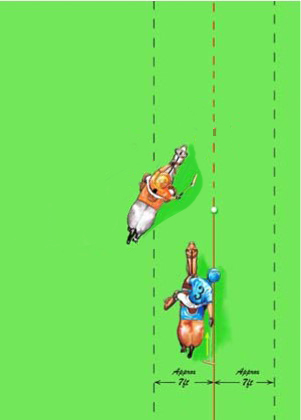 I close this article asking you to imagine yourself in the following scenario: your horse is running at approximately 30 mph, you are at mid field, you just hit the ball eighty yards straight to goal, you have an opposing player hot on your heels trying desperately to hook you, and there is no one in front of you. How fast would you be willing to run to prevent the opposing player from catching up to you?
Then when you are approximately twenty yards from the ball another opposing player on your left travelling at about half the speed you are going enters a foot and a half into your five feet ROW approximately ten yards in front of the ball (projected ROW). How do you think you are going to respond, and what do you imagine will be the outcome of that response with an opposing player within inches of hooking your mallet?
Next consider, if out of fear of a penalty two being called, or being kicked out of the game for continuous infraction of a rule, that defending player knew better than to Feed You The Butt.
HPA rule 24 c.
No player shall enter in front of the player on the LOB except at such a speed and distance that not the slightest risk of danger to any player is involved…
USPA RULE 12 b. – RIGHT OF WAY
No player may enter, cross or obstruct the Right of Way of the player entitled to it unless at such a distance that no risk of collision or danger to either player is involved.
I can almost promise, if HPA Rule 24, c. and USPA Rule 12, b. were enforced consistent with the way they are written, Feeding Of The Butt, (Blocking), would be greatly diminished, and the game of polo would have the chance of becoming that faster and safer game.
For the sake of the safety of the players of the game and the enjoyment of the sport, the LOB and the ROW on the polo field should accomplish for polo players what the lanes and the line of separation between the lanes on a two lane highway accomplishes for drivers of cars – a lane in which to travel safely to your destination.
Thank You Memo, Polo Times, and the players who break the laws of polo by creating such high-risk dangerous plays. I apparently needed each of those situations to inspire me to write this article. I can only hope that sometime within the next fifty years, this message will have served the beneficial effect of helping to make the sporting game of polo faster, safer and more enjoyable for all players (human and equine).
 In case you don’t know Rege Ludwig, here is a snippet taken from Wikipedia.
Rege Ludwig is a polo instructor and high-goal coach who has been playing and instructing polo for over 30 years.
One of his earliest and notable achievements was coaching the Aspen Polo Team with Doug Mathews, Memo Gracida (10 goals), Carlos Gracida (10 goals) and Tiger Neece to the winner’s circle of the US Open Polo Championship. Since his victory, Rege has coached many other high goal players such as Thomas Winter, Andre Weiss, Fabio Diniz, Sebastian Merlos, Julio Arellano, Piki Alberdi and Juan Martin Nero. Additionally, in 1998 Rege coached the United States Polo Team in the Federation of International World Polo Championship.
He is a contributing writer for Polo Player’s Edition, Germany’s Pace Polosport Magazine, and Polo Times. He is a member of the governing committees for polo in the United States. In 1994 at the request of the Hurlingham Polo Association he was chief umpire lecturer and forum head for the senior umpires and top ranked players in the UK. He is author of the polo DVD/video POLO: Hitting the Ball with Power and Accuracy, which has been adopted by the Federation of International Polo and distributed to all participating countries. He coaches annually in France, Germany, England, Switzerland, Belgium, Thailand, Canada and Denmark.
His first article that we have been given to publish, titled, CONFUSSION and can be found here: https://www.pbitg.com/confussion-by-rege-ludwig/


