 Rege Ludwig has authored two articles on the rules of polo and umpiring, which he has given me permission to publish here on my blog. In case you don’t know Rege Ludwig, here is a snippet taken from Wikipedia.
Rege Ludwig is a polo instructor and high-goal coach who has been playing and instructing polo for over 30 years.
One of his earliest and notable achievements was coaching the Aspen Polo Team with Doug Mathews, Memo Gracida (10 goals), Carlos Gracida (10 goals) and Tiger Neece to the winner’s circle of the US Open Polo Championship. Since his victory, Rege has coached many other high goal players such as Thomas Winter, Andre Weiss, Fabio Diniz, Sebastian Merlos, Julio Arellano, Piki Alberdi and Juan Martin Nero. Additionally, in 1998 Rege coached the United States Polo Team in the Federation of International World Polo Championship.
He is a contributing writer for Polo Player’s Edition, Germany’s Pace Polosport Magazine, and Polo Times. He is a member of the governing committees for polo in the United States. In 1994 at the request of the Hurlingham Polo Association he was chief umpire lecturer and forum head for the senior umpires and top ranked players in the UK. He is author of the polo DVD/video POLO: Hitting the Ball with Power and Accuracy, which has been adopted by the Federation of International Polo and distributed to all participating countries. He coaches annually in France, Germany, England, Switzerland, Belgium, Thailand, Canada and Denmark.
Here is the first article, titled,
CONFUSSION
When reading the rulebook, I find myself sometimes confused by what I read. A large portion of that confusion is related to understanding the meaning of the words – Rule, Enter, and Cross-, and the phrases: Line of Ball and Right of Way. When I find myself being confused, I resort to the dictionary in an effort to develop a more clear understanding of the message the rulebook is espousing.
My understanding of teaching polo comes from a common sense understanding of what safety and fairness for all players’ means, (human and equine). I derive my understanding from what I read in the rulebook, and the words I look up in the dictionary.
I do not present my understanding as representing a legal, or binding, interpretation of any rules put forth by any group espousing an interpretation of the rules. My intention is to express what I understand about the rules from having read and studied the rulebook on many occasions.
The place to begin my discussion of confusion is by defining the word Rule, which According to the Oxford Dictionary of English, is: 1. “… a set of explicit or understood regulations or principles governing conduct or procedure within a particular area of activity.“… or 2. ” a law or principle that operates within a particular sphere of knowledge, describing or prescribing what is possible or allowable.” I start with the word rule because of the book of rules (laws, regulations, principles) that describe and prescribe what is possible and allowable; or more to the point, what is not possible or not allowable.
Keep those definitions of Rule in the forefront of your mind as you read on; they will prove to be critical in understanding what is allowed, or not allowed, when playing the sporting game of polo.
The next definition is for the phrase Line of Ball, (LOB). There is no definition in the dictionary for that phrase; therefore, I use a definition that I perceive as being generally accepted throughout the world of polo. The LOB is an imaginary line projected onto the ground by the ball. The LOB follows the direction the ball is travelling either on or above the ground. The LOB is not necessarily a straight line; it curves to the degree that the ball curves within the process of traveling above or on the ground.
To take that definition a step further; the portion of the line ahead of the ball in the direction the ball is travelling is referred to as the Extended, or Projected, Line, while the line behind the ball, from the direction in which the ball has already traveled, is referred to as the Established Line.
Those two terms (Projected and Established) will prove to be significant to the purpose of determining how the LOB effects the playing of the game.
The primary purpose served by the imaginary LOB is that it serves as a dividing line between two imaginary Right of Ways (ROWs), one on either side of the LOB; with each ROW extending the length of the LOB, and running parallel to it.
The next definition is that of Right of Way (ROW). The term ROW unfortunately is often equated to the LOB, and that is truly unfortunate, as the two are entirely separate entities serving their own unique function to the safe and fair playing of the game.
With that point having been established, I refer to the Oxford Dictionary of English to develop a more accurate understanding as to what a ROW is, and how it can be and should be used to play the game of polo safely and fairly.
The definition of Right of Way has two distinct definitions as applied to polo:
- “…. the legal right, …. , to pass along a specific route… a path or thoroughfare… .”
- “…. the legal right … to proceed with precedence over others in a particular situation or place….”
Relative to the game of polo, the ROW is first and foremost, a lane or path on either side of the LOB that runs contiguous with the length of the LOB, is parallel to it, and leads directly to the ball.
Secondly, the ROW is a precedence allowing the player who is safely positioned within the physical established ROW the precedence to continue forward to the ball in that ROW without encountering the slightest risk of danger from an opposing player.
Once safely positioned within the established ROW, that player has the right to continue within that lane, (ROW), over other players who have yet to safely enter within the established ROW in front of the player already positioned there.
A difficulty in recognizing the ROW and correctly applying its function to the game of polo is that each ROW is an imaginary lane defined partially by an imaginary LOB. Those two imaginary factors combined can make the physical aspect of the ROW difficult to realize; thereby, making the precedence aspect even more difficult to discern.
With my having grown up in the world of polo under the rules of the United States Polo Association, USPA, my understanding of the ROW is greatly influenced by – USPA RULE 24, RIGHT OF WAY, which states –
- At each moment of the game there shall exist as between any two or more players in the proximity of the ball a Right of Way, which shall be considered to extend ahead of the player(s) entitled to it, and in the direction in which that player or those players is or are riding.
- The Right of Way, …, is not to be confused with the line of the ball, nor does it depend on who last hit the ball.
- No player shall enter or cross the Right of Way except at such speed and distance that not the slightest risk of a collision or danger to any player is involved.
The problem I have with USPA Rule 24 is that it does not describe what a Right of Way is.
It is not until 2009 that the Hurlinghan Polo Association defined in their rulebook that the ROW is, “a five-foot path extending from the ball to the players nearside foot.”
HPA Rule 32 c. Possession of the Ball. A player may not block the progress of an opponent in possession by positioning himself in such a way that his opponent cannot move forward. A player in possession should be allowed approximately 5 feet wide measured from the ball to the player’s near side leg to continue down the LOB. Preventing the player from moving forward (shading) is done at all speeds and should be blown straight away and any penalty must be moved up the field.
From the way I read HPA Rule 32 c. and USPA Rule 24; If an offensive player is safely positioned within the established ROW, is parallel to the LOB, and has the ball on their offside; they have the precedence to hit the ball.
Consider that, if there is a defensive player on their nearside of the offensive player with the precedence to hit the ball; and, if the last layer of chrome added to the defensive player’s stirrup enters into the ROW, either established or projected, in front of the offensive player, that defensive player is running the risk of fouling. And, the closer to the offensive player that entry occurs, the greater becomes the risk that the defensive player is fouling. The operative word is enter not cross, and the operative phrase is ROW not LOB.
For my purpose of teaching polo, I make a distinction between being in the ROW (path or lane) and having the right, precedence, to hit the ball. I do that because, you can be in the ROW, and near the LOB; however not completely within the ROW, and/or you are at an angle to the LOB (not parallel), and under both conditions, you could be fouling; thereby negating your right, to hit the ball.
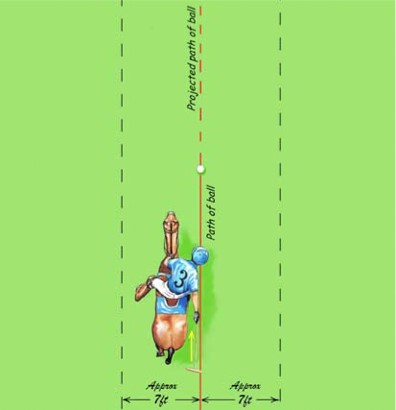 HPA Rule 24 – Line of Ball, Subparagraph d. When no player is on the exact LOB and two or more players ride in the same general direction, whether following or meeting, the player riding at the lesser angle to the LOB has precedence. If the players are at equal angles, the player that has the LOB on his off side has precedence.
The physical aspect of the ROW, path or lane, gets you safely to the ball. While the precedence of being in the ROW, path or lane, gives you the right to hit the ball upon arriving at it.
Two other words that confuse me are: “enter” and “cross”. Unfortunately, those two words are often times used interchangeably, and should not be; because each has its own meaning and serves its own function to the process of playing the game of polo.
According to the Oxford Dictionary of English, “enter” is defined as – “Come or go into (a place) … penetrate.” In other words, pierce or penetrate either of the two bordures of the physical lane or path (ROW).
Where as the word Cross is defined as – denoting movement … across something… . passing from side to side. V. [with obj.] 2. go or extend across or to the other side of (an area, …)
By way of those two definitions, it should be obvious that entering the ROW and crossing the LOB are entirely different sets of circumstances. As a matter of fact, on either side of the ball, you will have entered the ROW before you cross the LOB.
 Relative to developing the right to hit the ball, that right revolves around satisfying the stipulations associated with both the ROW and the LOB; consequently, you must first safely enter the established ROW, or lane; then position your horse to be at the least angle to the LOB as possible, i.e. parallel, then stay within the confines of the ROW, (lane), up to point of contact with the ball.
From my perspective as a teacher of polo, there are three distinct sets of circumstances under which a ROW can be occupied:
- Having the Absolute Right to hit the ball
- Having the Primary Right to hit the ball
- Having the Secondary Right to hit the ball
Having the Absolute Right necessitates satisfying four criteria:
- Enter the established ROW without having created the slightest risk of danger to any player (human or horse).
- Be positioned completely within the established ROW, and parallel to the LOB.
- Have the ball on your offside,
- Be the first player to arrive at the ball having satisfied the first three criterions.
When you have satisfied all four criteria of having the Absolute Right to hit the ball, no other player on the field has a greater right to hit the ball than you.
HPA Rule 24 b, 2018. A player on the exact LOB with the ball on his off side, whether following or meeting, has precedence over all other players except when meeting two players … .
The Primary Right comes with a limited right access, and can be executed under the conditions that you:
- Have entered the established ROW safely
- Have the ball on your offside
- Have your horse positioned within the ROW; however, at an angle to the LOB. Under such conditions, you could be fouling; thereby, negating your right to hit the ball
- Are much closer to the ball than the opposing player positioned within the established ROW behind you.
The Secondary Right comes with even greater restrictions than the Primary Right. The Secondary Right falls under the conditions of:
- Having safely entered the established Right of Way on the right side of the ball
- Having the ball on your nearside
- Being as parallel to the LOB as possible
- Being the player closest to the ball under the above three conditions, with no opposing player coming from the opposite direction with the ball on their offside
CAUTION – Utilize extreme care when hitting the ball on the nearside; because, if an opposing player is riding to the ball from the opposite direction at any angle to the LOB with the ball of their offside, that player has a greater right to hit the ball than you. That holds true even if you are positioned completely within the established ROW, you are parallel to the LOB, while the opposing player is at an acute angle to the LOB, coming against the direction of travel of the ball, and is completely outside of the lane, or ROW.
HPA 2017 RULE 24 b. A player on the exact LOB with the ball on his off side, whether following or meeting, has precedence over all other players….
USPA 2017 Rule, 24 e. No player may have the ball directly in front or on the near side if by doing so an opponent is endangered who could have safely attempted to hook the player or to hit the ball had the original player been placed with the ball on the off side.
Compare that to your traveling in a car on a two-lane highway, and wanting to pass a slow moving car from the right lane. Just as you decide to pass, you realize that a car from a side street has entered the same lane that you are in, but is traveling in the opposite direction as you. At that point, your passing without the slightest risk of danger has been severely comprised.
The rule over the years that I have found to be the easiest for me to understand is USPA rule 26 Dangerous Riding, Subparagraph e. Exhibiting a lack of consideration for the safety of one’s self, one’s mount, or for another player or mount. That rule (Law) is straightforward, and is stating that anything a player does that could be construed as presenting the slightest risk of danger to any player, (human or equine), is a foul!!!
A similar rule in the HPA rulebook is from Part 2: HPA Regulations & Supplementary Rules for Polo, Rule 15 – Blowing to Stop the Clock, subparagraph c. For Players or Ponies. –
The umpires have a responsibility to do all that they can to prevent accident or injury to players or ponies and to protect the image of the sport.
Relative to the image of the sport, as a consequence of modern day perceptions of polo within the horse industry, I strongly urge that protecting the image of the sport of polo should become a much greater concern then it appears to have become.
The essence of the rule situation is, a rule is a law, or a set of explicit or understood regulations or principles prescribed to govern the conduct or procedure of play for the purpose of ensuring the safety and fairness of play for all players (human and equine). The acceptance of that understanding does not seem to have resonated throughout the world community of polo the way it should.
If you have not been confused by what you have read up to this point, then you should be pleased to know that this information lays a foundation for next months’ Polo Times editorial article dealing with making the game of polo a faster and safer game to play.