

Five days ago, I posted on this blog that the Department of Veterinary Services had announced that African Horse Sickness had hit Malaysia. DVS revealed their case history of these five horses in Kuala Terengganu Manir, to a joint EAM-MRA-RMPA Task Force on Friday.
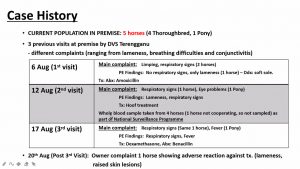 The blood samples were taken from horses on 12th August and sent to the VRI laboratory in Ipoh for analysis. They were found to be positive to African Horse Sickness.
Four weeks have passed, and despite the horses not being isolated in vector-proof stables, no other horses in Terengganu have shown any symptoms of African Horse Sickness. Thank God for that.
When African Horse Sickness hit Thailand in March this year, it spread like wildfire. Spread by midges called Culicoides, 607 horses were very quickly infected. Thailand immediately locked down, stopping movement of horses nation-wide. They wrapped their stables in 40-mesh vector-proofing, and offering assistance to stables that needed it.
Still, 565 horses died because of African Horse Sickness in Thailand, in a matter of five months. That is a mortality rate of 93.08%.
In Malaysia, we have only locked Terengannu down, and frankly, there is no enforcement of it. The Task Force wanted the whole northern corridor locked down at least, but DVS said there was no need as no cases were reported anywhere else.
The allegedly afflicted horses remain alive, now a month later, showing no clinical signs of AHS other than really poor health because of the terrible conditions they live in. They have not been isolated in vector-proof stables, causing great concern and outrage by most of the Task Force.
In a census I did in April, Polo alone has 885 horses. At an average imported cost of US$30,000 each, that is US$26.5 million of MYR112 million invested in polo ponies. Racing, with 1,500 horses will have a considerably higher imported cost. It is estimated that equestrian has around 500 competitive horses in Malaysia.
Not only do we need to protect our investments and our equine industry – we have a duty to protect our horses.
If the five horses in Terengganu have African Horse Sickness, I am of the opinion that those horses should be put down immediately, as the spread of African Horse Sickness would decimate equine sports in Malaysia. So far, despite assurances that they will be put down, DVS has not even insisted on vector-proofing the stables they continue to live in.
With no overt symptoms other than conjunctiva, which could be because of the appalling conditions they are living in, none of the five horses have died. Unlike Thailand, which, despite their precautions had 93% mortality, Malaysia has 0% deaths.
 It appears that there has been no spread of the disease yet.
There is no nasal discharge from the five horses. Some very senior vets have questioned the clinical signs.
Is it really African Horse Sickness?
Can we afford to find out? I understand the industry’s insistence these horses are put down post haste. I agree with it. These poor horses are in such poor condition they need to be put out of their misery in any case.
However, I do have my doubts if indeed it is African Horse Sickness, because the biggest clinical sign of nasal discharge is not there, the mortality rate is 0% in Malaysia when the accepted mortality of AHS ranges from 70% to 95%, and there has been no evidence that it has spread.
If we continue to accept that this is African Horse Sickness, Malaysia loses its disease-free status. No horses from Malaysia could travel anywhere for the next two or three years. That would be a huge blow to all the equine competitors in Malaysia, be they equestrian, polo or racing. We cannot continue to dream of SEA and Asian Games medals.
My suggestion is that the five horses in Terengannu be put down, but that new blood samples be taken for independent foreign testing in UK or Australia.
If the results are negative, we may at least save Malaysia’s disease-free status. If they are positive, we will know for sure African Horse Sickness is here and the millions about to be spent on vector-proofing by clubs and stables will be justified.
Related Links:
African Horse Sickness Hits Malaysia
Thailand Today 2020 EP114 : African Horse Sickness AHS crisis in Thailand
Thailand getting on Top of AHS
African Horse Sickness Outbreak in Thailand
Thailand Battles African Horse Sickness


