

 Rafiq Radinal kindly asked if I could write something about how the South East Asian World Cup Jumping League was formed, as Indonesia are holding CSI-W shows there, keeping this league going, 23 years after it was started. Here’s a slightly longer version of my contribution:
The road to the World Cup started sometime in 1994. Australian International Course Designer Ted Dwyer declared after the 1994 Xanthus Showjumping Open in Singapore that South East Asia should be ready for World Cups in a couple of years. As Ted was the Pacific League coordinator of the FEI World Cup, we reckoned he knew what he was talking about. When Ted repeated that statement after building a successful Rolex Singapore Grand Prix that went up to 1.40 m in 1995, we started to take him seriously.
Ted was the course designer at the Chiang Mai South East Asian Games in December 1995. It had been a borrowed horse SEA Games, where riders drew for horses provided by the host country. Because of a lack of health protocols for horse movements, this had been the norm of competitions in South East Asia till then. Ted again spoke to me at the games, saying again that it was time.
At the farewell party of the games, senior riders like Ardi Hamidjojo, Major (now Lt Col.) Sam Deva and myself got together and made a pact that we would force the issue by refusing to ride in borrowed horse competitions for our countries and instead push for internationals on our own horses.
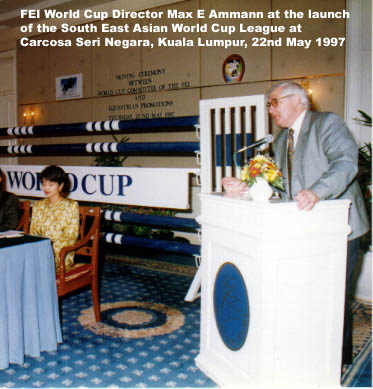
A month later Ted delivered a proposal I had written, to Max E Ammann, the director of the FEI World Cup. I proposed a South East Asian World Cup Jumping League, with qualifiers in Malaysia, Singapore, Thailand and Indonesia. With Ted’s recommendation, Max read the proposal and was excited enough to invite me to present this proposal to the World Cup Committee during their session at the Eighteenth World Cup Final in Geneva in April 1996.
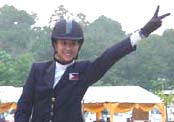
Mikee Cojuangco-Jaworksi
It started the wagon rolling. We needed a team from South East Asia to support the presentation. Haji Fathil of Malaysia, now Tan Sri Mahammad Fathil, was invited, and he was one of the most enthusiastic supporters of the World Cup idea. Ho Nai Yue has risen to the top of the sport in the FEI but in 1996 he was still a fresh face, a newly promoted candidate judge from Singapore. Thailand sent George Anuman-Rajadhon as their representative from Thailand. We were joined in Geneva by Mikee Cojuangco (now Cojuangco-Jaworski) and Toni Leviste, who were enthusiastic supporters, even though they did not represent their federation at that time. Mikee was later to become President of the Philippine Equestrian Federation and made history by becoming an IOC Executive Council Member this year.
The proposal for a league was presented to the World Cup Committee on Saturday 20th April 1996. The World Cup Committee was chaired by William Steinkraus. Others on the committee who listened to our presentation were the then FEI Treasurer Conor Crawley, Jose Alvarez de Bohorques, Katie Monahan-Prudent, Jacinte Giscard d’Estaing who is the daughter of former French President Giscard d’Estaing, Frank Chapot, Rider Representative Franke Sloothaak, veteran British equestrian journalist Alan Smith, and of course, World Cup Director Max E Ammann. Mid-way through our presentation Her Royal Highness Donar Pilar de Bourbon, the President of the FEI, slipped in without ceremony, to catch our presentation.
We talked about our plans to have World Cup shows in Malaysia, Indonesia, Singapore and Thailand in 1997, with inclusion of riders from Philippines and Brunei. We presented our plans for making it a circuit of shows. We showed the committee our level of jumping and show facilities. We were able to impress them that Malaysia already had an indoor arena (Bukit Kiara) as big as the huge Palexpo arena that was being used for the Geneva World Cup Finals that year. A short video of a Merdeka show that had been held in Johor Bahru in 1995 that had Aussie World Cuppers Alison Rowland and Ron Easey riding in it was shown.
Before the Geneva World Cup Final was over, Ted Dwyer and Alan Smith told us that our proposal had been accepted, and subject to an inspection visit by Max Ammann, we were to form the South East Asian World Cup League, the 13th league in the FEI World Cup Jumping family. We celebrated with a sushi dinner and started the planning for the enormous task ahead.
 Max Ammann made his grand tour of the four South East Asian countries that were to host qualifiers – Malaysia, Singapore, Thailand and Indonesia – in early 1997 to inspect the host venues. By then, Rafiq Radinal had got Indonesia onto the World Cup wagon. N Y Ho took Max to Indonesia, while I introduced him to Sam Deva in Thailand. Tan Sri Fathil and I handled Max’s tour of facilities in Malaysia. Like a band of brothers, we reunited in Singapore: Tan Sri Fathil, Farouk Khan, N Y Ho and myself. The FEI was represented by Secretary-General Bo Helander and Max Ammann. Over a Chinese New Year Eve dinner, we all shook hands and the South East Asian World Cup League was formalised.
We have been told we were able to impress the FEI with our enthusiasm and close friendships. In those days South East Asia equestrianism was a small circle, and then, our friendships were firm.
By December 1996, 3Q Equestrian had already hosted an invitational event. Riders from Thailand and Singapore brought horses to test the newly established health protocol for movement of horses that is still used today, most recently at the 2019 SEA Games.
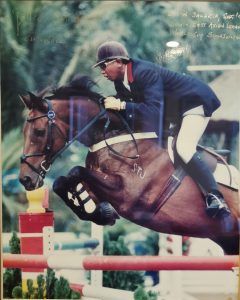
Peter Abisheganaden and Chakwal, competing at CSI-W SEA League World Cup, Jakarta 1997.
The inaugural World Cup was held at 3Q Equestrian on 31st August 1997. Riders from five South East Asian countries participated: Singapore, Thailand, Indonesia, the Philippines and Malaysia. The league ran an impressive eight World Cup qualifiers that inaugural year, with qualifiers in Malaysia, Indonesia and Thailand.
We flew our horses to Jakarta and back. The story of the inaugural flight is best told by Helena Gabrielsson and Julie Hicks who travelled with the horses and survived a terrifying descent facing the wrong way.
The World Cuppers then trucked the horses to Thailand and back, jumping at Garden City Polo.
What a season!
I competed two horses, my old faithful Peshawar, and Chakwal, who would be my World Cup horse for the next five seasons and finished 3rd in the league in the first year, I think. I earned an invitation to jump in the World Cup ‘B’ Final at Helsingborg, Finland the next year, but had to decline because of the costs. The FEI world ranking points earned in the World Cups was related to prize-money, and I rose to a career high 168 in the world rankings.
Perhaps being the 13th World Cup League was unlucky. The first SEA League World Cup year was marked by the exit of Volvo after 19 years of World Cup sponsorship. It left the organisers in a bit of a pickle, having advertised a prize-money of US$25,000 for the first few events, only to have the worldwide sponsor bail out. It was Mercedes Benz that stepped in to sponsor the South East Asian League Final that was held at Bukit Kiara’s indoor arena in 1997.

Ted Dwyer (right) with Graeme Watts
Ted Dwyer was not in the best of health, and while he had been promised he could design the first South East Asian World Cup, the task went to his Australian mate Graeme Watts. Princess Diana’s death also cast a shadow over the 1st World Cup event. Ted did finally get to build a SEA League World Cup, at the Rolex Polo & Equestrian Championships in Singapore in 1998. We were honoured that Ted chose to make it the last World Cup he ever built.
Ted passed away in 2013, just a few days short of his 90th birthday. His friend, Alan Smith wrote, “The huge contribution that Ted has made to show jumping in Australia and in parts of South-East Asia, where he is something of a godfather figure, would be hard to exaggerate.”
The first two World Cup Leagues were won by Manila-based riders. American Julie Hicks was the SEA League winner in 1997, while Toni Leviste and Leap of Faith won in 1998. While our league has always accepted “extras” like Helena Gabrielsson who has won the league twice, in 2001 and 2005, the league has always promoted local riders. The extras do not take away the rights of the best South East Asians from participating in the FEI World Cup Finals.
The 1998 final was held in Saraburi, Thailand, just before the Asian Games. 1999 was blighted as the Nipah virus necessitated a ban on movement of horses in Malaysia. The SEA World Cup League still held five events in Indonesia. Endaryanto Bambang was the first Indonesian league winner.

Toni Leviste – Leap of Faith
The winner of the South East Asian World Cup League is invited to participate in the World Cup Final. Our league winner Toni Leviste (PHI) took this opportunity to compete in the 1999 FEI World Cup Jumping Final in Gothenburg, Sweden. It was her introduction to the world stage, and Toni went on to compete in the 2000 Sydney Olympics and the 2008 Beijing Olympics.
In addition to our World Cup classes, a Young Rider League was run in tandem with the South East Asian World Cup League, over the same courses, but at lower heights. This focused interest on the next generation.
World Cups were the first CSI shows ever held in South East Asia. The standard and quality of shows as risen dramatically over the years with participation in our league expanding to include riders from Australia, Chinese Taipei, Hong Kong and Korea.
Despite the many geographical, health and political challenges, the South East Asian World Cup Jumping League lives on. It serves a cause, a stepping stone to the world’s equestrian stage.
Long may it continue.


