

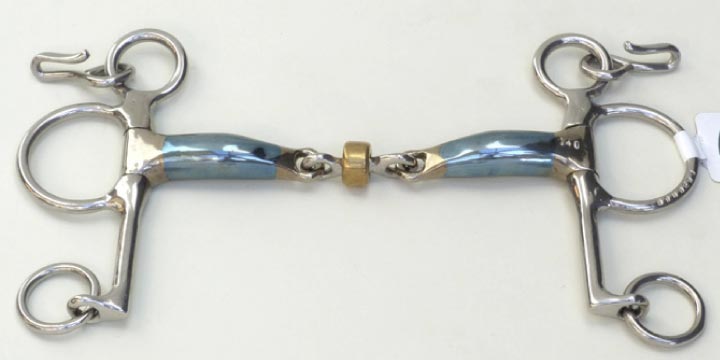
In talking to new owners, and in running Zack’s Tack, I find there is less and less knowledge of bits and bitting. It is not enough to say your polo pony uses a “polo bit.” Which is a bit like saying “my car runs on wheels.” Of course it uses a ‘polo bit.’ A polo bit is any bit that works on your polo pony.
The only bit that is not allowed in polo is a hackamore. In other words, anything else that works is a polo bit. It can be a snaffle or gag snaffle, or a curb, whether it be a pelham or even a double bridle. Generally, polo ponies play in gags or pelhams. Both are what we know as ‘leverage bits’.
Gags are snaffles that have extra leverage with the bottom ring lifting the bit in the horses’ mouth, creating a gag effect as it moves upwards in the horse’s mouth. It tends the bring the head up as the horse stops.
A pelham is a leverage bit, meaning that it multiplies the pressure applied by the rider. Unlike a snaffle bit, which applies direct rein pressure from the rider’s hand to the horse’s mouth, the curb can amplify rein pressure several times over, depending on the length of the curb’s bit shank. With a correctly fitted curb chain, it tends to bring the horses head down as you stop.
Here is a good explanatory article from The Horse: Bits and Bitting. If you really want to get into it, check out this website: https://www.horsebitbank.com/articles.html.
The use of draw reins are are whole different question and not to be confused with bitting. Having said that, the generalisation that all horses should play polo in draw reins is an ignorant assumption.
Zack’s Tack stocks eggbutt and loose ring snaffles, Dr Bristols, universals and French links. In Gags, the standard in polo is the large ring gag, but we will also bring in Barry Gags and other special gags. In Pelhams we have jointed, hard rubber pelhams, mullen mouth, port mouth and the Argentine coscojueros with copper rollers. Copper and blue steel increase salivation in the mouth. A moist mouth is essential for any bit to work.
I’ve been collecting bits for ages. I’ve got about 30 different bits that you won’t find in your normal tack shop. I first started when I was showjumping. We used to have a saying that the correct bit was whatever worked best on your horse. While we are guided by principles, really, the best way to find out what works best is to try different bits till you find the magic one. The joke was that if it was ‘the kitchen sink’, that’s the bit you should use.
Always remember, bits are a communication tool. The best way to communicate with your horse is through your legs and seat.


