

mde
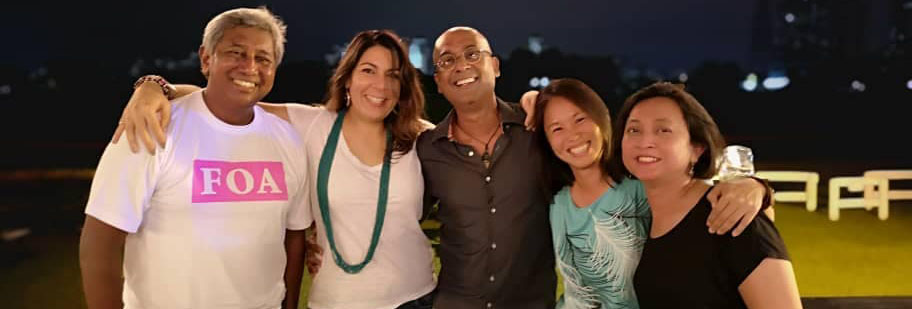
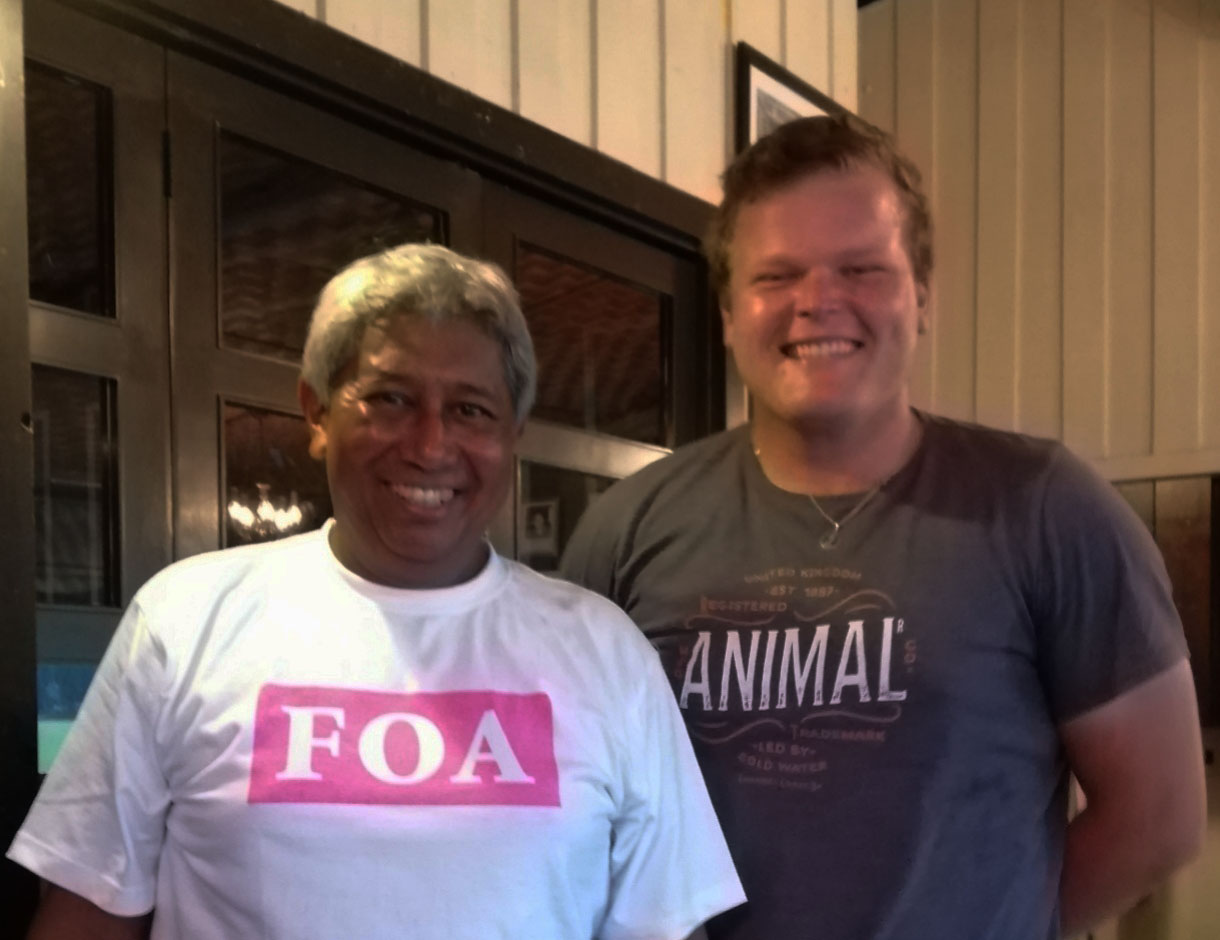
I was cleaning out my cupboard yesterday, looking for team shirts I could offer at the Tack Room Garage Sale, and came across an old FOA tee that I had saved from the 2011 FIP World Cup Zone D Playoffs. Here I am above at the club with the Happy Klappers, and on the right with KL Academy of Polo‘s Coaching Director Andrew Gebbie with my famous FOA tee. Very people have it, or know what it means. To understand its significance, read on.
The 2011 FIP World Cup Zone D Playoffs remains the largest zone play-offs ever staged. Seven countries took part, with games played at the Royal Pahang Polo Club and Royal Selangor Polo Club. We had many local and foreign dignitaries attend, and so security was very high. Access was controlled by use of accreditation cards.
RMPA engaged a young German programmer called Lars Wendelken to help us with the accreditation process. Lars’ company provided the software and trained our volunteers how to run the system.
Each accreditation pass had the player or official’s name and photograph on it. It also had colour codes abbreviations that granted the holder access to different areas.
Players did not get the dark green STB that officials got to give them access to the stables. This was to ensure stable security in the borrowed horse event. There were abbreviations of VIP that got them into the VIP lounges, GSD for grandstand and MED for Media.
We prepared two thousand accreditation cards to be printed. Lars taught us how to accredit people by internet or as they came to the venue.
Lars explained that of the biggest problems in Malaysia is that we have too many Dato’s. “Everyone is a Dato’, and they all want special treatment. Everyone will want an accreditation card, even if they are not really part of the event. They may not even attend the event, but will demand an accreditation card.”
As HRH Sultan of Johor allegedly once said, ““In Malaysia, if I were to close my eyes and throw a pebble, it may hit the head of a Datuk and that same pebble may bounce off the head of another Datuk, and if luck has it, the pebble may also hit a Tan Sri.”
As we pondered how we would handle this problem, we came to the conclusion that it would be easier to give them a card than have daily fights with such people.
That agreed, the next problem was what access to give them? We decided that if they weren’t going to attend the event, they didn’t need access. However, the accreditation system would not allow us to print a card with no access codes. We asked Lars how he usually handled it. He said, “That’s easy. I just create another fictitious area and give it a code. Then when these monkeys come, I print their card with only that code. They are happy and the problem is solved.”
Brilliant, we thought. We will do the same.
But wait, what three-letter abbreviation would we use?
“Well” , said Lars, “I usually use F.O.A.”
Why FOA, we asked? “I call it the FOA because it is the Fuck Off Area.”
Well that worked for us. FOA it was, on a pink background.
At the World Cup, it turned out that there were so many people that ‘needed’ these cards that we had to reprint another thousand cards.
Another joke was that when some top officials realized that they didn’t have the pink FOA code on their card, some stormed into the Secretariat to demand that they get a card that had the FOA on it. With pleasure, we said and gleefully printed the FOA access for them.
After the tournament, as a thank you to all who helped in the secretariat, I had tee-shirts made with FOA on the pink background. Here are the originals back in 2011 (from left to right: Lars Wendelken, Col Azrin, Gines Bargallo, Sue Crawford, Carlos Pando and Bev Whittel. Not in this photo are Natasha Mustapha, Estefania Etchart, Hannah Daniels, Ali Mazlan and myself.)


